

Best Bitcoin Casino in Canada 2026: How to Compare Payout Speeds, Fees, KYC Rules and Bonuses Before You Deposit
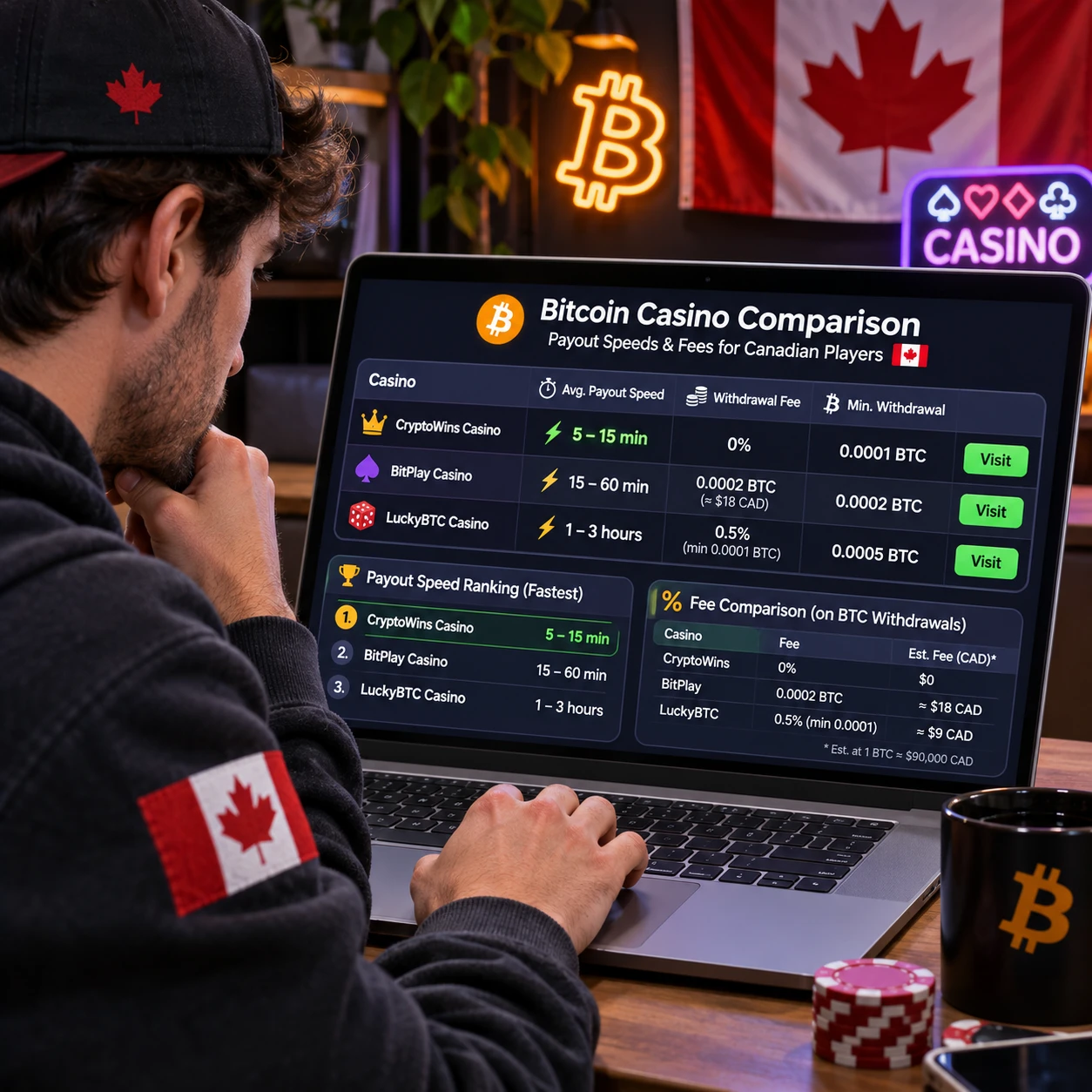
Open any crypto casino landing page in 2026 and the same three words hit you in bold: instant payouts. Ontario's regulated iGaming market has grown up, Bitcoin went from novelty to mainstream with younger Canadian players, and every operator now swears it's the fastest, cheapest, most private option on the internet. Some of them are telling the truth. Plenty aren't — and the gap between those two groups is the whole reason this page exists.
I'm not going to hand you a ranked list and ask you to trust it. Affiliate rankings move with commission rates, not with quality. You can watch a brand climb four places in a month because the rev-share got renegotiated, and nothing about the product changed at all.
What I can give you lasts longer: a four-point comparison method built on payout speed, fees, KYC rules and bonus terms. Read those four properly and you'll never need someone else's opinion about where to deposit. One note before we start — gambling is age-restricted in Canada (19+ in most provinces, 18+ in Alberta, Manitoba and Quebec), and offshore crypto casinos sit outside provincial regulators and their dispute mechanisms. That last part matters more than most articles admit. I'll come back to it.
Why Bitcoin Casinos Appeal to Canadian Players in 2026
The pull factors are real. Crypto deposits settle without a bank pre-authorisation step, so nothing gets declined because your card issuer flagged a gambling merchant. That one matters more than people expect — plenty of Canadian players have had a legitimate deposit bounced by a bank's own risk rules, and there's no appeal process for it.
Withdrawals can land in your own wallet instead of sitting in a pending queue tied to banking hours. Provably fair verification hands players something land-based casinos never offered: a way to check that a result wasn't tampered with. And then there's the privacy argument — a wallet address instead of a line on your statement.
The counterweight deserves the same space. Crypto casino balances have no CDIC-style protection, because that insurance covers bank deposits, not gambling accounts. There's no provincial complaint process for an offshore operator, no ombudsman to escalate to, no regulator to fine a company that simply stops answering emails.
Speed and privacy are real benefits. Recourse is what you pay for them.
Regulated Ontario Sites vs. Offshore Crypto Casinos
In Ontario, iGaming Ontario licensees operate under AGCO oversight: CAD accounts, mandated identity checks, published responsible-gambling tools and a formal complaints route. Offshore brands that accept BTC are a different category entirely.
They're often faster and less intrusive. But when a withdrawal goes missing, your options shrink to support tickets and, eventually, a chargeback you can't file because crypto payments are irreversible. Neither model is automatically better. They're different trade-offs, so pick the one whose downside you can actually live with.
Payout Speed: What 'Fast' Really Means
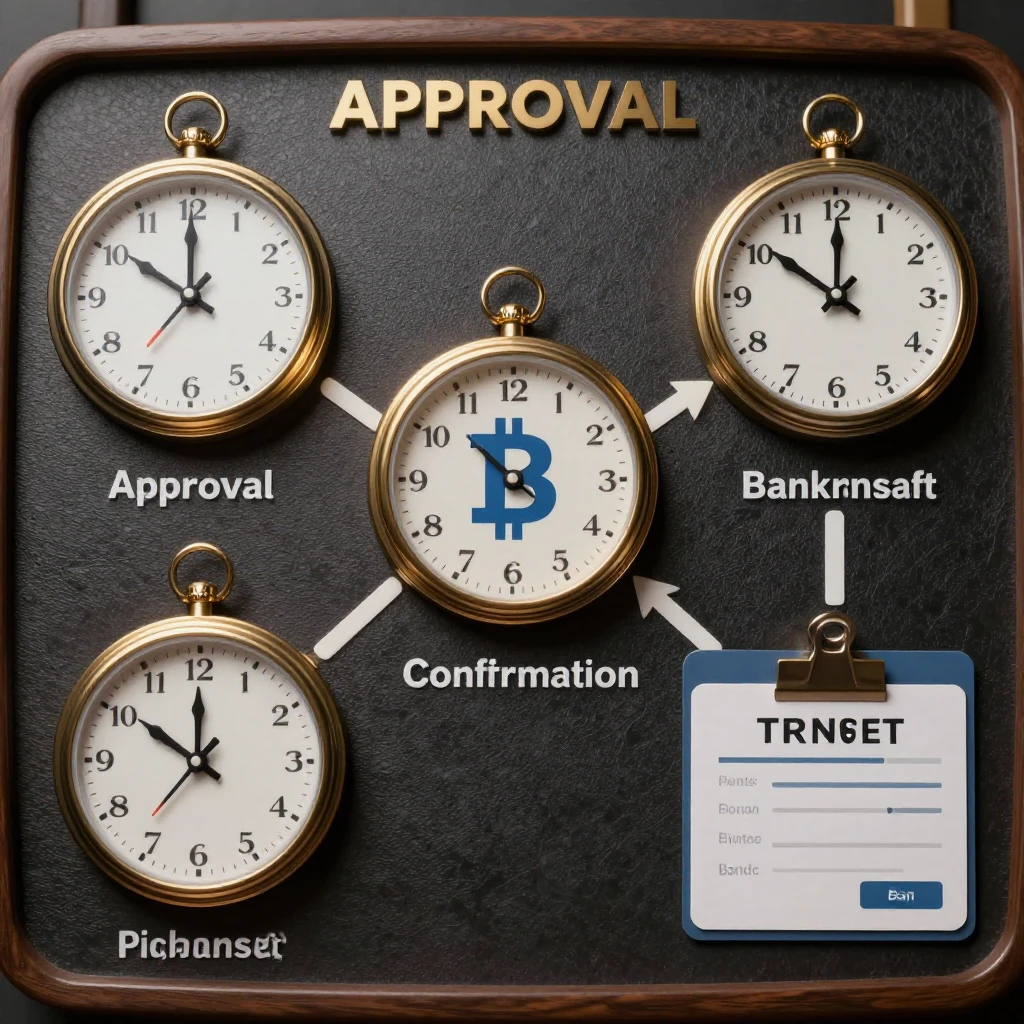
'Instant' almost never is. A crypto withdrawal runs on three separate clocks, and the casino controls exactly one of them.
- Internal approval: the risk review on the operator's side. Ten minutes at a well-run site, up to 72 hours at one that batch-processes on weekdays.
- Blockchain confirmation: minutes for a first confirmation on Bitcoin when the chain is calm, considerably longer when it isn't. Lightning Network and stablecoin transfers on fast chains cut this down hard.
- The final hop: moving value from your wallet into a Canadian exchange, then to your bank. The step most reviews conveniently skip, and it can add a day.
Realistic 2026 benchmarks for the on-chain part: BTC typically 10–60 minutes, ETH a few minutes, LTC often under five, and USDT on a low-fee chain close to immediate. Congestion rewrites those numbers without warning, which is why a casino quoting a fixed payout time is either oversimplifying or being generous with the truth.
On-Chain Confirmation vs. Internal Processing Time
You can test speed before committing serious money. Make a small deposit, play a little, then request the minimum withdrawal in your first week. Write down exactly how long the approval takes and whether it lands before or after a weekend — the weekend case is where a lot of the marketing quietly falls apart.
Check whether the casino publishes median payout times; legitimate operators increasingly do. Then read the terms for batch-processing windows, which are usually buried three clicks deep.
E-Transfer and Interac as a Benchmark
Interac e-Transfer is the reference point most Canadians already understand: typically somewhere between one and 24 hours, depending on your bank and its fraud checks. If a crypto casino can't beat a plain e-Transfer, its speed marketing is noise. Hold every 'fast payout' claim against that baseline and the exaggeration shows itself.
Fees, Network Costs and the True Cost of a Withdrawal
Four different fees get muddled together, in reviews and in players' heads alike. Separate them and you can price a withdrawal accurately.
- Deposit fees: usually zero, sometimes a spread baked into the exchange rate.
- Withdrawal or processing fees: the operator's own charge, listed on the banking page.
- Blockchain miner fees: which the casino may absorb, pass through, or cap.
- Currency conversion: your account may be denominated in CAD while settlement happens in BTC, and that conversion is rarely free.
Worked example. You request $100 out. The operator charges a flat 0.0005 BTC withdrawal fee — at recent price levels that's roughly $20–$50 depending on the day — plus 1.5% for converting CAD to crypto, about $1.50 on a hundred.
Add a network fee you cover yourself and a nominal withdrawal can shed a fifth to a half of its value. On a $2,000 withdrawal that same flat fee is trivial.
That asymmetry is the single most useful thing to understand about crypto casino costs: they punish small cash-outs. Not by design, necessarily. But that's how the maths lands.
Reading the Fee Schedule Without Getting Burned
Fees live on the banking or cashier page, never the homepage. Find the minimum withdrawal threshold too, because that's the quiet trap — a site with a $50 minimum and a flat fee structure can make a $45 balance effectively uncollectable. If there's no fee table anywhere, ask support in writing and keep the answer.
KYC Rules and Licensing: What Canadian Players Should Expect
Know-your-customer checks exist for anti-money-laundering reasons and because licences require them. Most crypto casinos use tiers: email sign-up to start, government ID plus proof of address at first withdrawal, then source-of-funds documentation once amounts climb into the thousands. The threshold that triggers each tier is the number worth writing down before you deposit.
No-KYC Claims — What They Actually Mean
'No KYC' almost always means 'no KYC until you try to take money out.' A site promising genuinely anonymous cash-outs is either capping withdrawals at pocket change or running with no meaningful compliance at all, which is a different kind of risk entirely.
Anonymity and recourse pull in opposite directions. Decide how much of each you want before you sign up, not after a withdrawal is frozen.
Provincial Rules Worth Knowing
Canada's picture is a patchwork. Ontario runs a regulated market with licensed operators and clear consumer protections. Age limits vary by province. Quebec, British Columbia and others treat offshore sites differently from a consumer-protection standpoint, and provincial regulators have been increasingly active in blocking unlicensed domains. Where you live changes what happens if something goes wrong.
Bonuses and Wagering Requirements Decoded
Bonus maths is where most first deposits go to die. Four variables decide whether an offer is generous or decorative: the wagering multiplier, game weighting, the maximum bet allowed while clearing, and the expiry window.
Slots usually count 100% toward wagering; blackjack often counts 10%. So a $500 bonus at 40x with slots-only weighting needs $20,000 of play before a cent converts to cash. Add a seven-day expiry and a $5 max bet and the offer shrinks fast. Check whether the bonus is sticky (forfeited on withdrawal before clearing) or cashable, too.
The Real Value of a Bonus
Here's the formula that ends the argument: expected loss = wagering requirement × house edge. Those $20,000 of required play at a 3% edge means roughly $600 in expected losses against a $500 bonus — a net negative offer dressed up as a gift. Run that calculation on every promotion and 'generous' stops meaning anything.
How to Compare Casinos Before You Deposit
Five steps, in order. First, verify licensing and identify the parent company — a brand is a website, an operator is a business. Second, test a small withdrawal before you scale up. Third, confirm the full fee schedule including minimums. Fourth, map the KYC triggers and withdrawal limits. Fifth, cost the bonus against its terms using the formula above. Score each site out of five on each criterion and the decision makes itself.
| Criterion | What to record | Score /5 |
|---|---|---|
| Licensing | Regulator, operator name, complaints route | |
| Payout speed | Approval time, chain, total to bank | |
| Fees | Withdrawal fee, network fee, conversion, minimum | |
| KYC | Trigger threshold, documents, limits | |
| Bonus | Wagering, weighting, expiry, expected loss |
If you'd rather start from a shortlist than a blank spreadsheet, this roundup of the best bitcoin casino options for Canadian players is worth reading alongside your own checks — treat it as a starting point, then verify every claim against the operator's own terms, because terms change and reviews lag behind them.
Red Flags That Should End the Comparison
Unlicensed operation with no identifiable regulator. Withdrawal limits buried in the general terms. Bonuses with 100x-plus wagering. No published payout times anywhere. Support that can't answer a direct question about fees in writing. Each one maps back to one of the four criteria, and any single one is enough to walk away.
Frequently Asked Questions Before Your First Deposit
Are bitcoin casinos legal in Canada?
Online gambling laws are layered. Ontario licenses and regulates operators; elsewhere the picture is less clear-cut, and offshore crypto sites generally operate outside provincial oversight. Playing is not the same as having legal recourse, and the two get confused constantly.
How long do BTC withdrawals actually take?
Usually between 15 minutes and a few hours once approved, plus whatever time the operator takes internally. Weekends, congestion and first-time KYC checks are the common delays.
Do I pay tax on crypto casino winnings?
Casual gambling winnings are generally not taxable in Canada, but crypto movements can create capital gains or income consequences depending on how you hold and convert. Ask an accountant about your own situation — this is not tax advice.
What is the minimum deposit?
Often the CAD equivalent of $10–$20, occasionally lower. Check the minimum withdrawal as well; that number decides whether small balances are actually accessible.
Is a no-KYC casino safer or riskier?
Riskier on recourse, usually faster on cash-out. You're trading legal and dispute protection for privacy and speed, so keep balances small if that's the route you choose.
There's no universally best bitcoin casino in Canada for 2026 — only the best fit for your tolerance for speed, cost, verification and bonus complexity. Compare on those four criteria, deposit small, test a withdrawal early, and let the operator prove itself before you trust it with anything meaningful.
And set your limits before you play, not after. Gambling is for adults only, support is available through provincial programs and helplines, and no bonus is worth chasing past the point where it stops being entertainment.